
The Engineering Debt Nobody Talks About : Context Debt

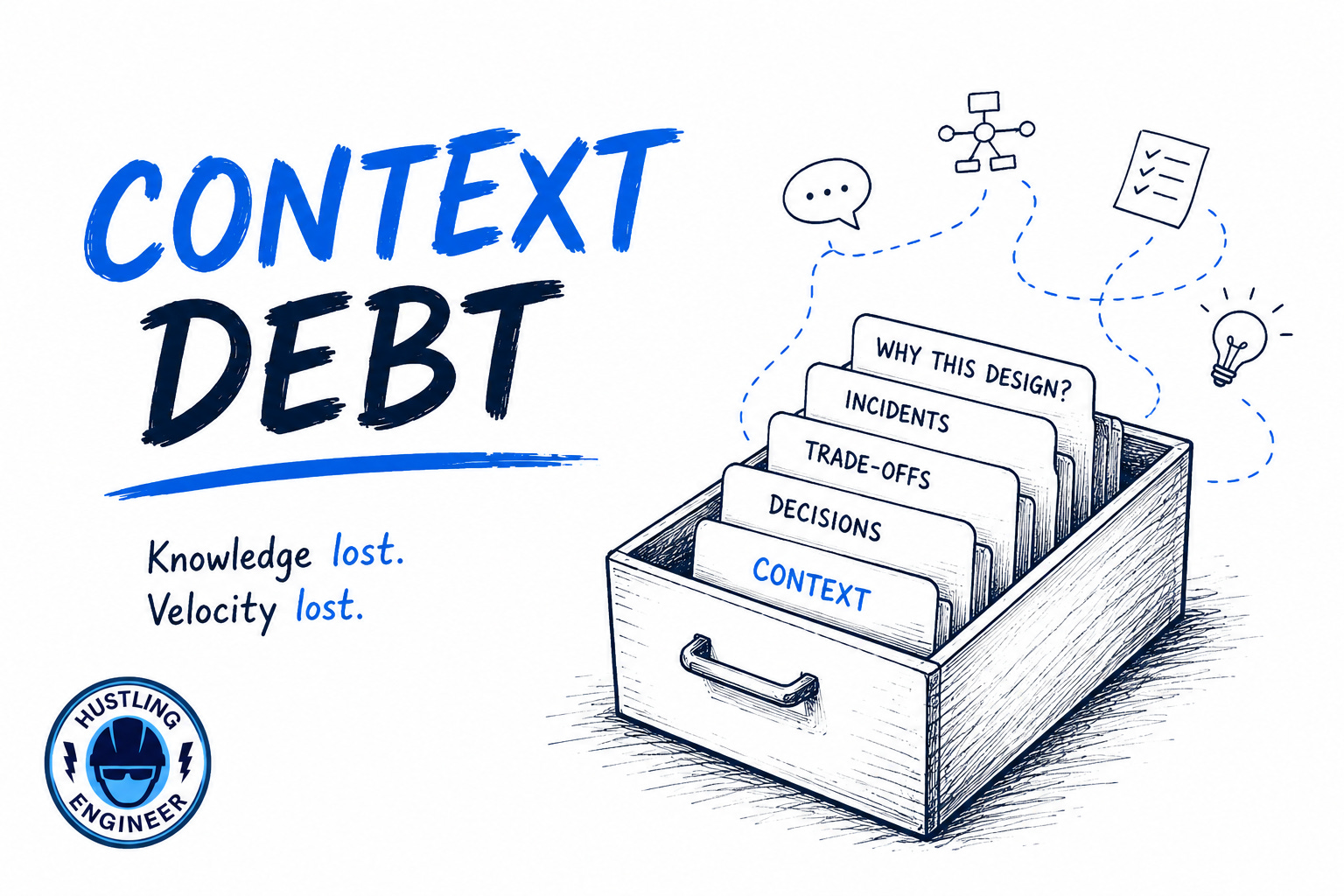
Last month I spent 3 hours debugging a service and the bug was not too difficult.
The fix ended up being a 4-line change.
The hard part was figuring out why the system existed in the first place.
Nobody on the team knew. Claude cannot answer it too as it has no context
The engineer who built it had left. The documentation was not there.
The Slack had random things. And every answer led to new questions.
At some point I stopped debugging the service and started debugging history.
That’s when I realized:
Most engineering teams don’t have a technical debt problem.
They have a context debt problem.
Before we dive in, do check out
“Break Into Senior Engineering Roles” Async Cohort
I have opened the application form for my next async cohort

If you are a software engineer with 2-10 years of experience and want to get the offer you deserve, you can check the details here and fill out the application form if interested
I handpick folks so that it is a focussed group, and members can get maximum value
Back to the topic,
A few years ago, I joined a team that had a service everyone was terrified of touching.
You know the type.
Whenever someone mentioned it during planning, the conversation would immediately get awkward.
People would look around the room. Nobody volunteered. Nobody made eye contact.
Everybody suddenly became interested in their laptop.
The funny thing?
The code wasn’t even that bad. It wasn’t some horrifying 20-year-old monolith.
The real problem was simpler. Nobody understood it. The engineer who designed it had left. The engineer who maintained it had transferred teams. The engineer who knew all the weird edge cases was now a manager.
The code survived but the context didn’t.
I’ve started noticing this pattern everywhere.
An engineer makes a decision. It makes perfect sense at the time.
Maybe traffic is growing. Maybe latency is high. Maybe a production incident just happened.
A tradeoff gets made. A workaround gets added. A cache gets introduced. A queue gets created.
Everyone nods. Problem solved.
Six months later nobody remembers why any of it exists.
Yet the implementation remains.
Future engineers walk through the system trying to interpret artifacts.
“Why is this retry count exactly 7?”
“Why do we have three databases?”
“Why does this endpoint only fail on Tuesdays?”
Nobody knows. The answers left with the people.
I think this is why some teams feel slow even when they have good engineers.
The bottleneck isn’t code. The bottleneck is understanding.
I’ve seen teams spend:
30 minutes fixing an issue
4 hours understanding the issue
I’ve seen onboarding take months because every explanation started with:
“Honestly, I’m not entirely sure.”
I’ve seen production incidents where the biggest challenge wasn’t solving the problem.
It was finding the one engineer who knew why the system behaved that way.
That’s not technical debt. That’s organizational memory loss.
One of the biggest red flags I look for now is this sentence:
“Let’s ask XYZ. They built it.”
If a system requires a specific human being to be understood, you’ve already started accumulating context debt.
At first it feels efficient. XYZ knows everything.
Then XYZ takes vacation. Or changes teams. Or gets promoted. Or leaves.
Suddenly the team discovers XYZ wasn’t just maintaining the system. They were maintaining everyone’s understanding of the system.
Those are very different jobs.
The weird part is that context debt doesn’t show up in dashboards.
Nobody has a metric for:
“Percentage of architectural decisions only stored in XYZ’s brain.”
Nobody measures:
“Hours spent reconstructing forgotten decisions.”
Nobody creates tickets titled:
“Recover historical context lost during 2022 migration.”
But teams pay the cost every single day.
The older I get, the less I believe software engineering is about code.
Code is only one layer. The harder challenge is preserving knowledge.
Because code can be copied but knowledge disappears.
And once context disappears, engineers start repeating old mistakes.
Not because they’re bad engineers. Because nobody told them why those mistakes happened the first time.
I’ve become slightly obsessive about documenting decisions now.
Not because I enjoy writing docs. I don’t.
I do it because Future Me is surprisingly bad at remembering Past Me’s ideas.
And if I can’t remember my own reasoning six months later, there’s no chance somebody else will.
Maybe that’s the real lesson.
The systems that scale aren’t necessarily the ones with the cleanest code.
They’re the ones where knowledge survives longer than the people who created it.
And that’s much harder than writing software.
It’s preserving understanding.
If you’ve worked on a team long enough, you’ve probably seen context debt firsthand.
If this article resonated with you, drop a like or comment or maybe share with your colleague :D
How can I help?
Join my cohort
“Break Into Senior Engineering Roles,” a live cohort course to help you prepare better and position yourself right for tech interviews and senior engineering roles. [Check Details Here]
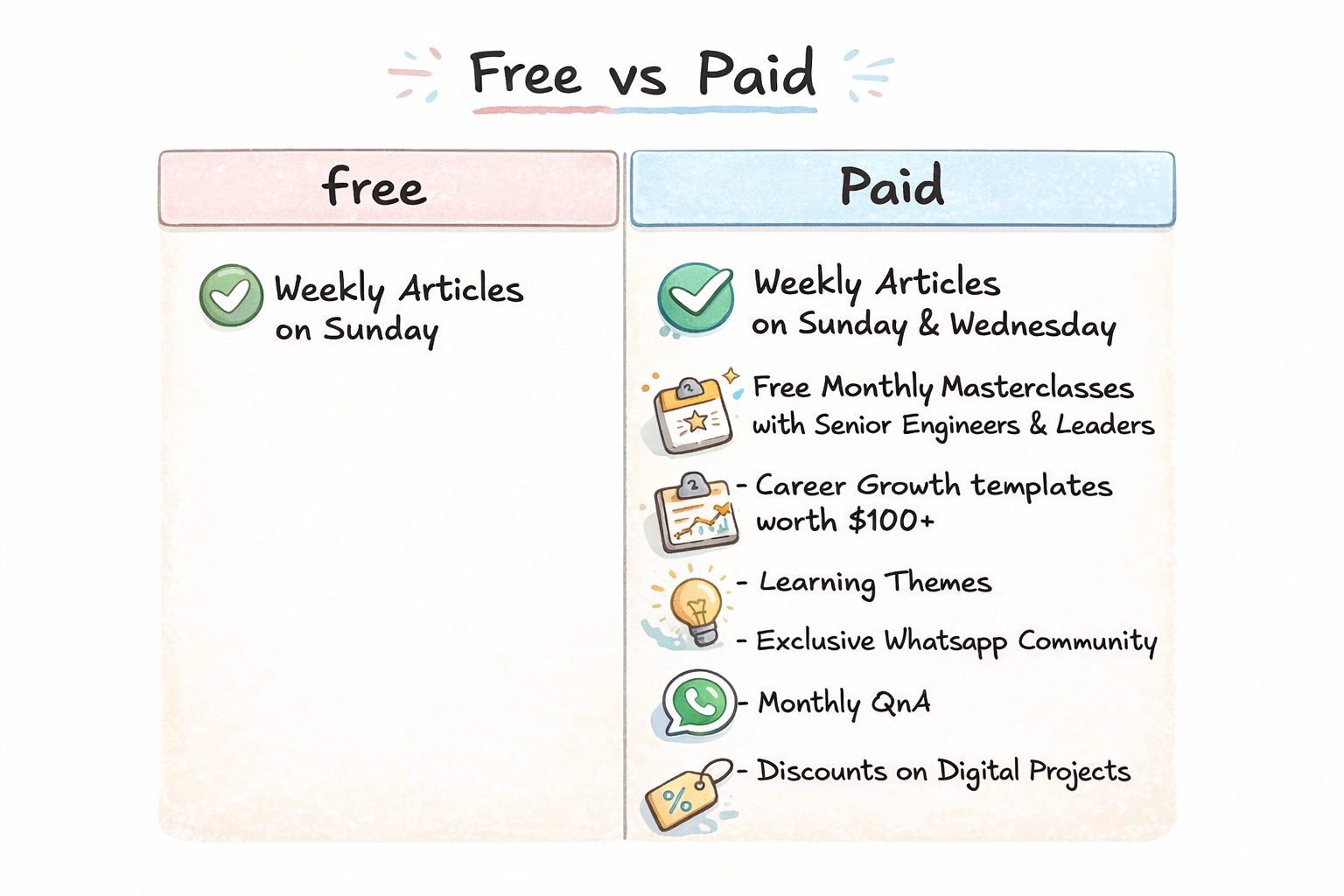
Be a Paid Subscriber
You can get maximum benefit of the high-performer community by being a paid subscriber here. Here are the benefits you get
Sponsor this newsletter
Want to reach 24,000+ senior engineers and tech leaders? [See sponsorship options]
Digital Products
Check out my digital products to help you grow better as a Software Engineer and Leader in Tech
Stay in touch
Find me on
Any questions? Just email me at hemant.pandey17@gmail.com
The line that lands hardest: Claude cannot answer why the system exists because it has no context. That sentence is also a comp thesis. AI now writes the 4-line fix in seconds, so the fix stopped being the scarce thing. Reconstructing why the system was built the way it was, who traded off what, is the part that does not commoditize. EY's Future of Pay 2026 already shows the split: AI, cloud and security specialists pulling 30 to 40 percent while the same title on commoditized work gets 6 to 8. Context debt is not just an ops risk, it is a map of who on a team is about to get repriced up. Zia. itszia.ai. On LinkedIn too, tag me when career-decision threads come up.