
Why do top 1% software engineers fail interviews?
How tech interviews are exactly opposite of work you do as a software engineer

Break Into Senior Engineer Roles
4th cohort will be kicking off in February [Check Details Here]

In Cohort, I provide
- Recordings + Notes + Live Sessions + Resume + Newsletter Paid Subscription + Whatsapp Community
In the recorded version, it will just be
- Recordings + Notes + Whatsapp Community
If you are interested, you can fill out the form
This bothers me a lot in my career
I see engineers failing interviews who are genuinely good at their jobs. The people teams depend on. The ones you trust in production incidents and trust their feedback in design reviews
Then I’d see someone else with less depth, less experience, and probably less technical too. And they would get the offer
It really feels unfair
Because in many ways, it is
A quick honesty check
I’m not a big fan of LeetCode-style interviews
I don’t think solving weird problems under time pressure is a great proxy for real engineering work. Most of us don’t invert binary trees or invent algorithms on a whiteboard in our day jobs
But here’s the reality
This is the system we’re dealing with
And pretending it shouldn’t exist doesn’t help your career
Understanding how to navigate it will probably help you get a better, higher-paying job
The mistake good engineers make
Good engineers walk into interviews assuming the interviewer will recognize their skill automatically, without putting extra effort
So they perform the way they do at work
They think quietly
They optimize early
They wait until they’re confident before speaking
That might work in real life in your job
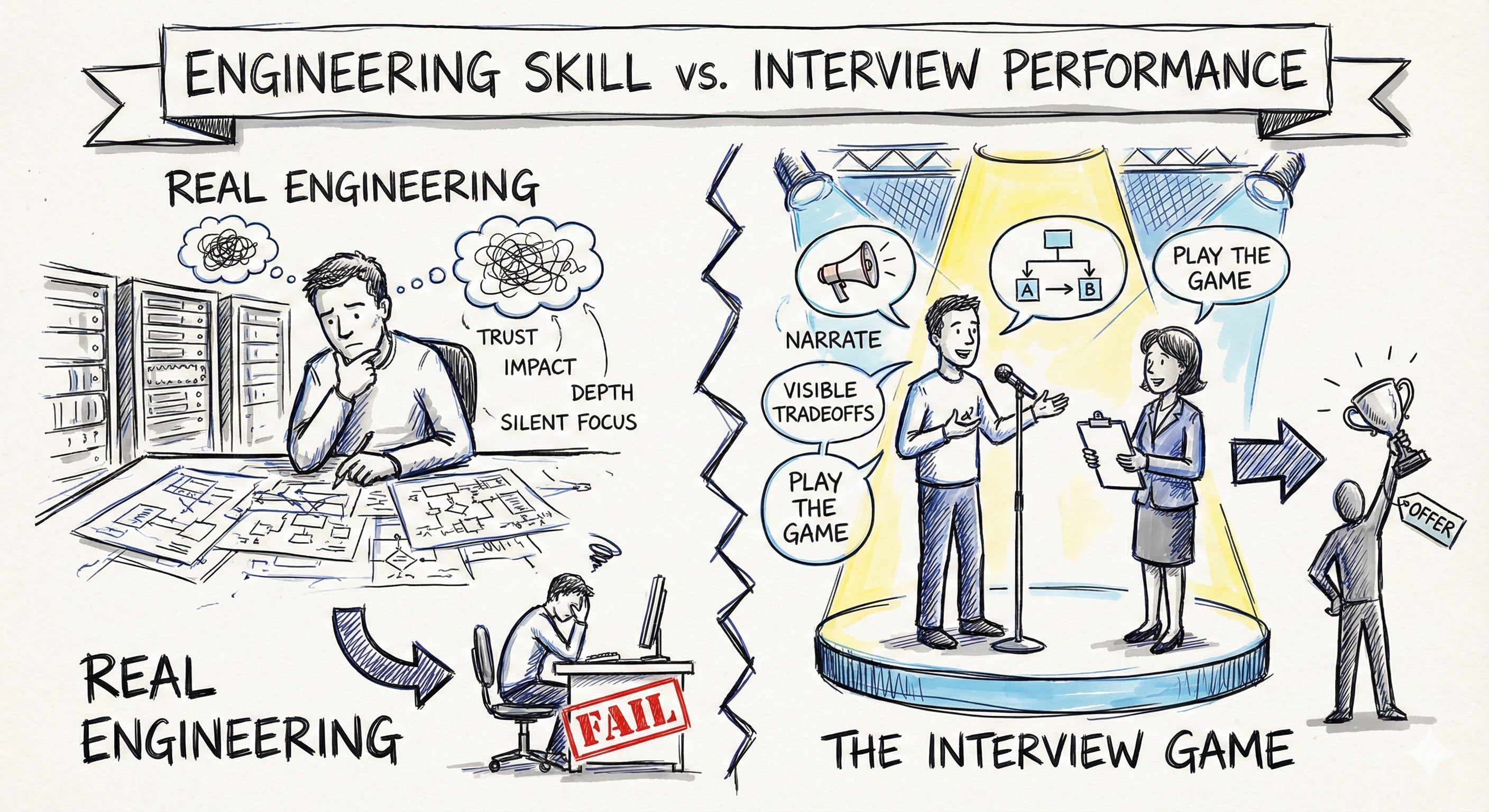
But the sad part is that interviews are not real life
Interviews are a compressed, artificial environment where the only thing an interviewer can evaluate is what you make visible
I always think of it like a sales call where the product is YOU
Interviewers collect signals
An interviewer has very little time and very little context
They don’t know the codebase you worked on
They don’t know the past impact you’ve created in your career
They don’t know how good you actually are as a software engineer
All they can do is extract the signals from that 30-60-minute call
So interviews quietly become a signal-extraction exercise
Not “Can you solve this perfectly?” but “Can I trust how this person thinks under pressure?”
Once you see interviews this way, a lot of confusion disappears
Silence is the most expensive mistake
At work, silence often means focus
In interviews, silence means that there is nothing to evaluate
When a good engineer goes quiet, the interviewer isn’t thinking, “This person is thinking deeply.” They’re thinking, “I don’t know what’s happening.”
A candidate who is good at interviewing talks more. Not because they’re better engineers, but because they understand the game. They narrate assumptions, explain tradeoffs, and verbalize half-formed thoughts
That narration alone creates confidence
Actionable step:
Practice saying out loud your thoughts. If you’re deciding between two approaches, say that out loud. Interviews reward visibility, not internal clarity
Why clarity beats cleverness
In coding interviews, good engineers often jump straight to the optimal solution. They’ve seen the pattern before
But the interviewer didn’t see the journey
One small mistake, and the signal collapses
Candidates who perform better usually start with a simple approach. They explain why it works, talk about complexity, and only then optimize if needed
The solution might be less elegant, but the thinking is easy to trust
Actionable step:
Even if you know the optimal answer, start with a simple baseline. Say why it’s correct, then improve it. Don’t skip steps
System design is not about flexing knowledge
System design interviews are 50% technical, 30% communication, and 20% time management
They’re still artificial.
But again, they’re the system we have.
Good engineers often jump into databases, queues, and scaling techniques too early. It sounds impressive, but it signals premature optimization.
What interviewers are really watching is how you make decisions with incomplete information.
Do you ask good questions?
Do you state assumptions?
Do you explain tradeoffs?
Those signals matter more than the tools or technologies you will mention during the interview
Actionable step:
Slow down at the beginning. Spend real time clarifying requirements and constraints. Say your assumptions out loud and invite correction.
Judgment matters more than correctness
Most interview rejections don’t happen because someone was wrong.
They happen because the interviewer didn’t trust the candidate’s judgment.
Not asking clarifying questions
Ignoring hints
Defending a bad decision instead of adapting
Good engineers often want to be right
Interviewers want someone they can reason with
Actionable step:
Treat the interviewer like a teammate. If they push back, adapt. Saying “That’s a good point, let me adjust” is a strong signal of maturity.
Why does this still feel unfair?
Because real engineering rewards depth, patience, and long-term impact
Interviews reward speed, clarity, and performance, and a little bit of acting
Same profession. Different incentives
You don’t have to like it. I don’t
But once you stop fighting the format and start playing it intentionally, results improve fast
How to practice without hating it
Don’t just grind LeetCode silently.
Practice the skill interviews actually test:
thinking out loud
explaining tradeoffs
staying structured under pressure
Solve fewer problems. Explain them better
That’s a much higher ROI
Final thought
Interviews aren’t a judgment of your worth as an engineer
They’re a test of how well you can make your thinking visible in a flawed system
Learn the rules. Play the game. Then get back to doing real engineering work
Here’s how I can help:
Join my cohort
“Break Into Senior Engineering Roles,” a live cohort course to help you prepare better and position yourself right for tech interviews and senior engineering roles. [Check Details Here]Sponsor this newsletter
Want to reach 23,000+ senior engineers and tech leaders? [See sponsorship options]Digital Products
Check out my digital products to help you grow better as a Software Engineer and Leader in Tech
Stay in touch
Find me on
Any questions? Just email me at hemant.pandey17@gmail.com